ブログ
英会話・英語 アミック – ‘No’ vs ‘not any’ vs ‘none’
Do you have any change?
No + noun
We can use the verb + no + a noun
- Sorry, I have no change
- I have no idea what you mean.
Don’t + verb + any + noun
We can use the negative don’t + the verb + any + the noun.
- Sorry, I don’t have any change.
- He doesn’t have any time to speak.
None
We can use none without a verb or a noun. It’s a short answer.
- Sorry, none at all.
5 Of American College Football’s Greatest Traditions – 英会話・英語 アミック
Autumn is an extremely important time of year for people that live in certain parts of the United States. In addition to the fall harvest, Halloween festivities, and Thanksgiving, it’s also the season for America’s third-most popular spectator sport: college football.
College football is a weird mix of modern commercial sport, 100-year old traditions, and sometimes ugly tribalism. This is especially true in the Midwest and southern parts of the country, where despite its short season, the sport is talked and thought about all year long. Similar to a religious pilgrimage, fans wait all year to make one or two trips to their favorite university team’s stadium, sometimes driving hundreds of miles in the process. Before the game, many tailgaters park in the same spot they have for decades, grilling food and playing games with younger generations whom will one day carry on the same customs with their own families.
Once inside the actual stadium, students, fans, and alumni observe or take part in school traditions that have been happening long before they were born. Every university with a football program could have a book written about their own history and customs, but here are five of my favorite traditions from across college football:
Running With Ralphie
Several schools have a live animal that serves as the school’s mascot. None of them however are as large as the University of Colorado’s Ralphie the Buffalo. Since 1934, five different Ralphies (along with five student handlers in charge of steering her) charge out onto the field before each home game. Occasionally Ralphie even breaks free or drags some of her handlers along for a ride.
Clanga-Clanga
There are certain ‘artificial noisemakers’ that can’t be brought into a sports stadium, such as airhorns or anything that makes so much noise the opposition can’t hear themselves think. That is unless you are Mississippi State, whose fans have been bringing custom-decorated cowbells to games since the early 1900s, when a cow wandered onto the field in the middle of a game. It is said that Bulldog fans can’t buy their first cowbell for themselves, but instead it must be gifted as a rite of passage.
Jump Around
What happens when you mix a nearly-30 year old hip-hop song and 80,000 University of Wisconsin Badger fans? Sometimes, an earthquake. In between the third and fourth quarters of every home game at Camp Randall Stadium, House of Pain’s “Jump Around” blares through the loudspeakers, prompting every person in the stadium to indeed jump up and down. The effect is so powerful that the tradition has been cancelled in the past due to concerns about the stadium’s structural integrity.
The Kinnick Wave
This tradition is only a year old, but all agree it’s a keeper. In 2017, the University of Iowa recently opened a new children’s hospital that overlooks the Hawkeyes’ football stadium. At the end of the first quarter of each home game, every fan, player, and coach in the stadium pauses what they are doing and waves to the children and their families watching from the hospital’s top floor.
Script Ohio
Who thought cursive handwriting could give someone chills? Since 1936, The Ohio State University Marching Band has been doing just that to Buckeye football fans whenever it performs ‘Script Ohio’. Starting from a block formation at the top of the field, band members high-step their way in a follow the leader formation, timing their steps perfectly as to not collide with each other when crossing paths, all while playing ‘Le Régiment de Sambre et Meuse’, an old French military march. The formation ends with the 228-band members spelling out Ohio and the customary bowing by the sousaphone player after he ‘dots’ the i.
Imotaki September 3rd「英会話・英語 アミック」
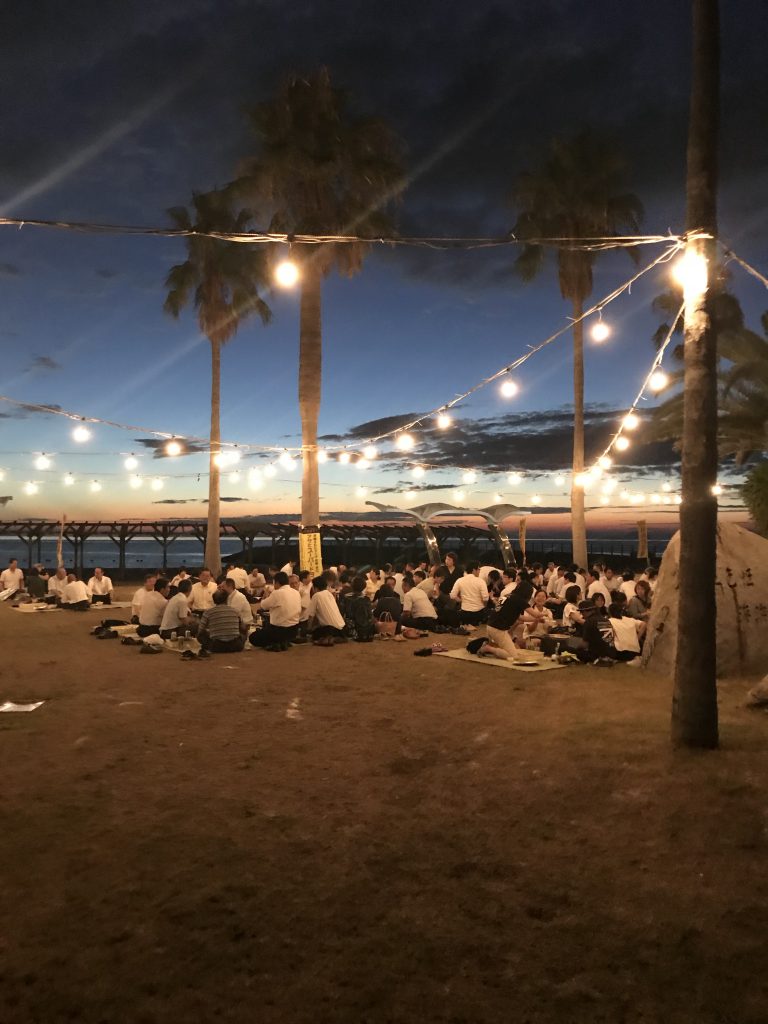
This past Monday Andrew-sensei and I went to an imotaki event at Goshikihama in Iyo-shi with my father-in-law and another friend from the States. It was a beautiful late-summer-not-quite-fall night, and the large pots of imotaki went great with the tall cans of Asahi as the sun set. There was also some entertainment: a group of taiko players! It was an ideal transition into my favorite season.
-Joe
The Day Wikipedia Went Dark 英会話・英語 アミック
When I’m looking for a topic for my weekly blog post, the first place I head to is *drum roll*… Wikipedia! I know Wikipedia gets a lot of negativity because it can be user edited, (and not always with correctly sourced information), but Wikipedia is truly a wealth of information. I, for one, love their homepage, because it’s the news and history, condensed. It’s up to me to see what piques my interest at that moment. If nothing does, fear not! I can always click “On This Day” and be whirled away to a list of birthdays, deaths, and other anniversaries. I love a good list and usually I can find an interesting read from either the homepage or the “On This Day” feature. I know I’m not the only one who loves Wikipedia. I haven’t gone so far as to create an account and edit articles, after all, I am but a mere plebe when it comes to research. That being said, I’ve used Wikipedia to write these blogs, to do research for essays in high school and college, to win arguments, to check spelling…the list goes on and on. I wondered, what would happen if Wikipedia just went away?
Once upon a time, Wikipedia tested this alternate timeline while protesting SOPA and PIPA, American bills that would censor websites, in 2012. Instead of its usual blue and white theme, the following image was displayed on the homepage:

While I applaud the website for shutting down (aka losing revenue) in response to an unjust bill, a different part of me says, a whole 24 hours without Wikipedia!? What about students who procrastinated and needed to get projects finished? What about people who always have to be right? What about people like me who check the Wikipedia homepage for fun? I suppose without net neutrality, using the internet for personal enjoyment would become a thing of the past anyway. I wish I could find reactions from Wikipedia-users in 2012 to Wikipedia’s black out, but alas, I don’t know how to optimize that search. My reaction? :

英会話・英語 アミック - Five uses of ‘get’
Five uses of ‘get’
Buy / obtain
Get can mean buy or obtain.
- I got myself a new phone last weekend.
- I need to get some new clothes.
Receive
Get can mean receive.
- I just got a message.
- I got a bike for my birthday!
Become
Get with an adjective can mean become.
- I’m getting annoyed.
- It’s got quite hot in here suddenly.
Understand
Get can mean understand.
- I don’t get this joke.
- I don’t often meet people who get this type of movie.
Arrive
Get can mean arrive.
- I need to get home early so I’m off!
- What time will you get here?
Umm-ing and like-ing your way to fluency – 英会話・英語 アミック
Recently at Amic, we did evaluations of our students’ progress with English. One of the criteria in which me measured our adult students on was their ability to ‘use hesitation mechanisms’ when speaking. In English, classic examples of these would be ‘um’, ‘uh’, ‘like’, ‘I mean’, ‘well’, and similar noises we make to show the other person we aren’t finished speaking and are thinking about what to say next.
Although it’s not something I’ve ever seen explicitly taught in an English textbook, I think using these filler sounds is an important step for any language learner wanting to sound like a native speaker. I may even start correcting my high-level students who fill their hesitation with etos and anos and see if it’s something that can be truly taught, or if they are something that just get ‘absorbed’ after listening to and interacting with enough native English speakers and media.
All of this also made me curious as to what filler sounds are used in other languages, and Wikipedia did not disappoint with me with their thorough list. Here are some interesting ones I came across:
- Chinese: en (um), zhège (“this”)
- Dutch: ehm (um), dus (“thus”), eigenlijk (“actually”)
- French: euh (um), bah, ben (“well”), tu sais, t’sais (“you know”)
- Persian: eh (um), bebin (“you see”), yaʿni (“I mean”)
- Polish: eee (um), no (“well”), wiesz (“you know”)
- Swedish: öhm (um), asså/alltså (“therefore”, “thus”), liksom (similar to “like”)
- Turkish: yani (“meaning…”), işte (“that is”), and falan (“so on”)
the greatest and best #1 stream of consciousness English conversation blog post ever **READ NOW** 「英会話・英語 アミック」
Well, dear reader, as of now I have nothing to say. Really. Nothing.
(silence)
**************
If I felt like this in an actual face-to-face social situation, I would perhaps feel obligated to make nervous small talk in the hope that it eased the tension of the silent room. But online, surrounded by Earth’s HIVE of BUZZING information peddlers and broke content creators (the information and “content” probably falling somewhere between dire and excruciatingly meaningless), I’ve found silence is golden. Shiny-soul-warming-morning-sunshine-on-your-face-after-a-good-sleep golden.
But do not fret, dear reader. I’ll have something to say next week. Something so unbearably important to tell everyone that I’ll practically race my own shadow to my laptop followed only by the hammering of my icy, air-conditioned fingers descending on the keyboard like a hailstorm in an attempt to convey everything as accurately as possible before it slips my mind forever.
Okay, no.
Not really.
Joe
英会話・英語 アミック 英語の俳句
こんにちは、アミック石井校の辰馬です。
気づかれた方もいるかもしれませんが、石井校の掲示板には、季節ごとにRoni先生が選んだ英語の俳句を貼りだしています。
俳句は、英語でも人気のある詩の形式で、文章を3行に分けて書いたり、季節の言葉を入れるというようなルールがあります。
今回Roni先生が選んだのは、
Summer night…
even the stars
are whispering to each other
という、小林一茶の句を英語に訳したものです。
元の俳句はどんな日本語だったのか、よかったら考えてみてくださいね!
(元の句は、「星さまの ささやき給ふ けしきかな」です♪)
Summer is still here
I can’t feel my favorite season coming to its end, but it is almost September. The wee hours are a little cooler that I sleep with my windows open. As I rode my son to nursery school today, the cicadas weren’t chirping as loud. Maybe they know that their time has come and that the typhoons are approaching us.
V-mail: not quite the predecessor of e-mail 英会話・英語 アミック
I’ve noticed a common trope when it comes to movies set during World War II: a soldier sends a letter to their family or sweetheart only for censorship to render it unreadable! Of course, censorship was an important tactic to use in an era of espionage and misdirections. Perhaps soldiers just had to learn how to censor their letters over time or they got yelled at enough times from their superiors to know better than to include locations and positions in their notes home. How were soldiers able to communicate with their loved ones? I, for one, would be devastated if my child or husband were in war and the only communication I received from them was full of holes! Enter V-mail!
Short for Victory Mail; V-mail was a hybrid mail process that was used during World War II for soldiers stationed abroad to send secure correspondence. How did it work? V-mail correspondence was written on small letter sheets, or paper that could be folded and sent without an envelope. The V-mail would than be censored and then photographed and transferred as a tiny image to microfilm. Once the V-mail arrived to its destination, the image would be printed at 60% of the documents original size.
According to the National Postal Museum, “V-mail ensured that thousands of tons of shipping space could be reserved for war materials. The 37 mail bags required to carry 150,000 one-page letters could be replaced by a single mail sack. The weight of that same amount of mail was reduced dramatically from 2,575 pounds (1168 kg) to a mere 45 (20.4 kg).This saved considerable weight and bulk in a time in which both were hard to manage in a combat zone.” [1] Wow!
In addition to postal censorship, V-mail also worked to stop espionage communications by “foiling the use of invisible ink, microdots, and microprinting, none of which would be reproduced in a photocopy.”[1] Who knew mail could be so fascinating?!