月別アーカイブ:2018年11月
The English Language’s Biggest Lie – 英会話・英語 アミック
At least in the American education system, every high school student gets drilled into their head a number of English “rules” that we later learn are completely false: don’t begin a sentence with “And” or “But”; paragraphs must be at least three sentences long; never split infinitives, and many others.
Perhaps the most famous and well-known of these misconceptions is that a sentence cannot end in a preposition (e.g., “Where is my coat at?” should instead be “Where is my coat?”).
Grammarians have been pushing back against this myth for literal centuries, arguing that these stranded prepositions are perfectly fine in modern English. For example:
What did you put that there for? is much more natural than For what [reason] did you put that there?
and
The same goes for The match was rained off. versus Rained off was the match.
So who’s to blame for this confusion?
According to Wikipedia, the guilt falls on the pen of Englishman John Dryden. A poet and playwright, Dryden argued in a 1672 essay that since Latin (seen as a more elegant language) sentences cannot end in prepositions, neither should English ones.
Even with so much opposition and most modern grammar resources (from Fowler’s Modern English Usage to the internet’s Grammar Girl) dispelling and denouncing the myth, for some reason it lives on and is still taught in classrooms today.
Webcomics and English: An educational match made on the internet 英会話・英語 アミック
Thanks to the internet, there are seemingly endless ways to learn and practice English. Today, I’d like to focus on webcomics. Webcomics are very aptly named in the sense that they are exactly what they sound like; comic strips hosted on a website. Unlike newspaper or magazine comics, webcomics can be started by nearly anyone with an internet connection and basic drawing skills. The beauty of using webcomics to learn English is that nearly every webcomic deals with a different aspect of Western life. Some webcomics can be political or contain social commentary, such as Questionable Content and Scenes From A Multiverse. Some can be fun and educational (funducational?) like Hark! A Vagrant and xkcd. And some can be downright weird and hilarious like Wondermark, Dr. McNinja, and BOASAS. Whatever your story preference is you can find a webcomic that fits the bill. Learn different English expressions and metaphors, as well as clever Western humor, all in three to five frames! Enjoy!
7 More Words My Kindle Has Taught Me (Pt. 3) – 英会話・英語 アミック
Turns out I still haven’t learned every word in the English language (but I’m working on it). Here are seven more words I came across recently that I had never seen (or at least remembered) before.
- Canard: a false or unfounded rumor, story, or belief
- Furtive: done secretly, stealthily
- Inchoate: being imperfectly formed or only partly in existence
- Limn: to draw or paint on a surface; to outline in sharp detail
- Spume: frothy matter/foam/scum on liquids
- Sui generis: unique, particular, in a class of its own
- Yegg: safecracker, robber
Happy Mole Day! 英会話・英語 アミック
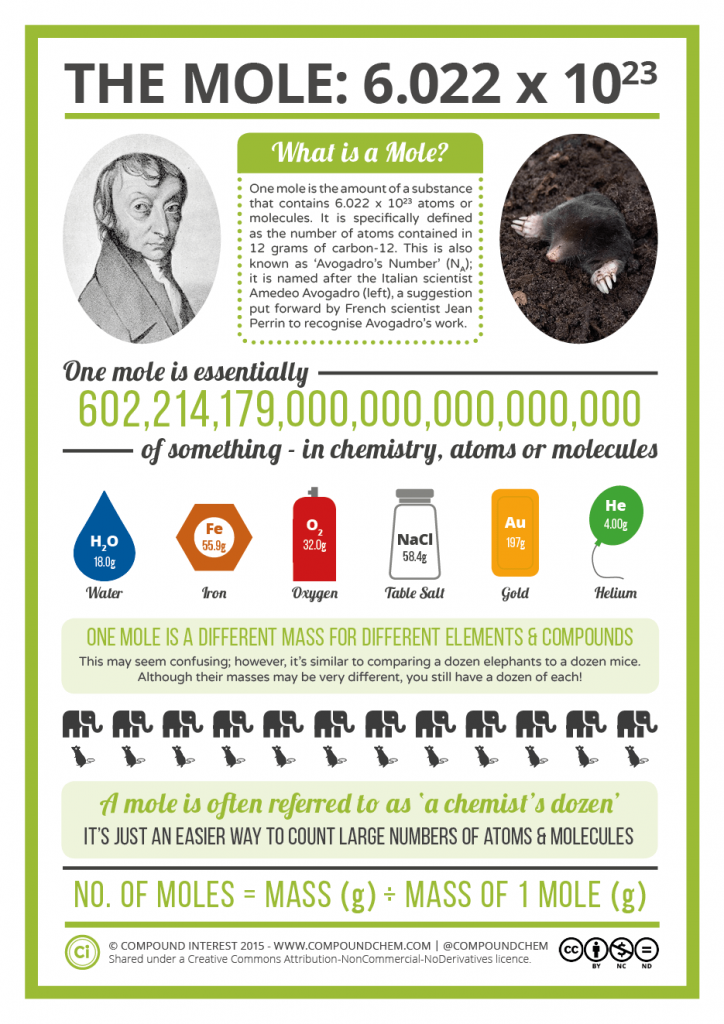
If you’re a chemistry enthusiast and/or huge nerd, you’re in for a treat! Mole Day, which is an integral part of National Chemistry Week, is the celebration of Avogadro’s Number. You may be asking yourself, “What in the world is Avogadro’s Number?!” As I am no chemistry devotee, I took the time to look this information up for you, dear reader. Avogadro’s Number (or Avogadro’s Constant, if ya fancy), named for famed Italian scientist, Amedeo Avogadro, is the number of molecules in one mole. I understand that you may be shouting “Now, what the heck is a mole?!” at your computer screen. Fear not, dear reader, a mole is but the unit of measurement for amount of substance. Simply put, moles give chemists more accuracy when it comes to determining amounts of substances produced in a given reaction. Okay, maybe that wasn’t so simple, but the mole is a very useful unit of measurement. The measurement is approximately 6.022140857(74)×1023 mol−1 (and yes, I copied and pasted that formula). And so on this October twenty-third in the year two thousand and eighteen, and every October 23rd hereafter, between the hours of 6:02 A.M. and 6:02 P.M., we celebrate the mole. I recommend a visit to the American Chemical Society for more Mole Day activities and crafts to get you in the spirit to celebrate your favorite unit of measurement.
For those of us that are still confused; here’s a handy chart!:
英会話・英語 アミック – Phrasal verb with “run” (part 3)
Run in
- Meaning: Arrest
- Example: The guys who robbed the bank last week have finally been run in.
Run in
- Meaning: Use new machinery at less than full speed, preventing damage
- Example: I have to drive slowly for the first 1,000 miles to run the engine in.
Run into
- Meaning: Enter by running
- Example: He ran into the building.
Run into
- Meaning: Collide with
- Example: He lost control of the vehicle and ran into a tree.
Run into
- Meaning: Encounter or meet unexpectedly
- Example: I ran into your cousin the other day.
Run into
- Meaning: Cause to blend into
- Example: You can use the paintbrush this way to run the colors into each other.
Run into
- Meaning: Reach a large figure
- Example: By the end, the cost of the project ran into the millions of dollars.
Run low
- Meaning: Near the end of a supply of something; to be nearly running out
- Example: Our stocks of meat are running low.
RUN OFF meaning – Phrasal verbs with RUN
Run off
- Meaning: Flee or depart quickly
- Example: Don’t run off before the end of the event.
Run off
- Meaning: Make photocopies, or print
- Example: Please run off a couple dozen more flyers to pass out.
Run off
- Meaning: Write something quickly
- Example: Shakespeare could run off a play in just a couple of days.
Run off
- Meaning: Pour or spill off or over
- Example: They kept a barrel to store rainwater that has run off the roof.
Run off
- Meaning: Chase someone away
- Example: If anyone comes into this field, the bull will soon run them off.
Run off
- Meaning: Operate by a particular energy source
- Example: This radio runs off batteries.
Run off with
- Meaning: Leave with someone with the intention of living with them or marrying them
- Example: The chief accountant has run off with his secretary!
Run off with
- Meaning: Steal or abscond
- Example: He ran off with my wallet.
Run on
- Meaning: Continue without interruption
- Example: We can’t afford for the performance to run on for more than the specified time.
Run on
- Meaning: Using a certain time zone
- Example: I was still running on daylight savings time.
Run on
- Meaning: Continue talking for a long time
- Example: She ran on and wouldn’t let anyone get a word in edgeways.